Getting started with a big renovation project: What is a feasibility study and how can it help?
Knowing where to start is one of the most common hurdles our clients face when getting starting with their renovation. Often there are multiple options for the overall design/ layout, each which will have timing, cost and planning implications.
For example: whether (and how) to extend or focus on an internal reconfiguration.
This is where getting an expert is really worth the investment early on, as we can assist you in making positive and confident early decisions, which in turn make the rest of the project more efficient.
Our usual first step on any project, is to produce an overview budget and timeline.
This will include all the work & fittings the client might be considering and will be split by specialist fees, contractor labour costs and 2nd fix costs. By undertaking this early on, clients can make informed decisions about what to include or remove from their brief to meet their cost and timeline goals. It also serves as a useful guide throughout the project. When decisions are made on works/ fittings, if those costs don’t align with the budget, we all know costs will either need to be reduced elsewhere or the brief/ budget adapted.
However, sometimes it isn’t possible to provide costs without first looking at design possibilities. This is where a more in-depth ‘Feasibility Study’ can help.
What is a Feasibility Study?
Feasibility studies usually combine a number of different pieces of work & research in order for clients to make informed decisions about what routes to take (or not take) for their renovation project. For example, before you invest lots of time and money pursuing a potentially controversial planning application, you might get professional advice on the likelihood of it being approved by planning. This could include reviewing other options and considering the cost & outcome implications of delays or planning changes.
Example 1:
We had a client who had inherited a large property which had been extended at different points but now needed a full renovation. They found the layout didn’t work well for their current and future needs so wanted help to identify:
How the layout could be improved to meet their needs now and in the future
The approximate costs for different layout options
The timing implications of each option (including overall timeline and whether the work could be done in phases and what the impact would be on completed/ lived in areas).
We undertook a feasibility study for them, whereby we produced a number of workable layouts, provided costs and time implications for each layout and then discussed the pros and cons with them so the options were clear. As part of this we provided context & illustrative plans for layouts which didn’t work to help our clients understand all the options and to rule out things which don’t meet their brief (or building regulations).
Layout showing options for extending the awkward loft space
The clients in this case ultimately decided that whilst they could make improvements none of the options were perfect and therefore their budget was better spent improving what was necessary for sale, then buying a different property which better met their needs within their budget. We then assisted in the full renovation of the new property (which you can see here).
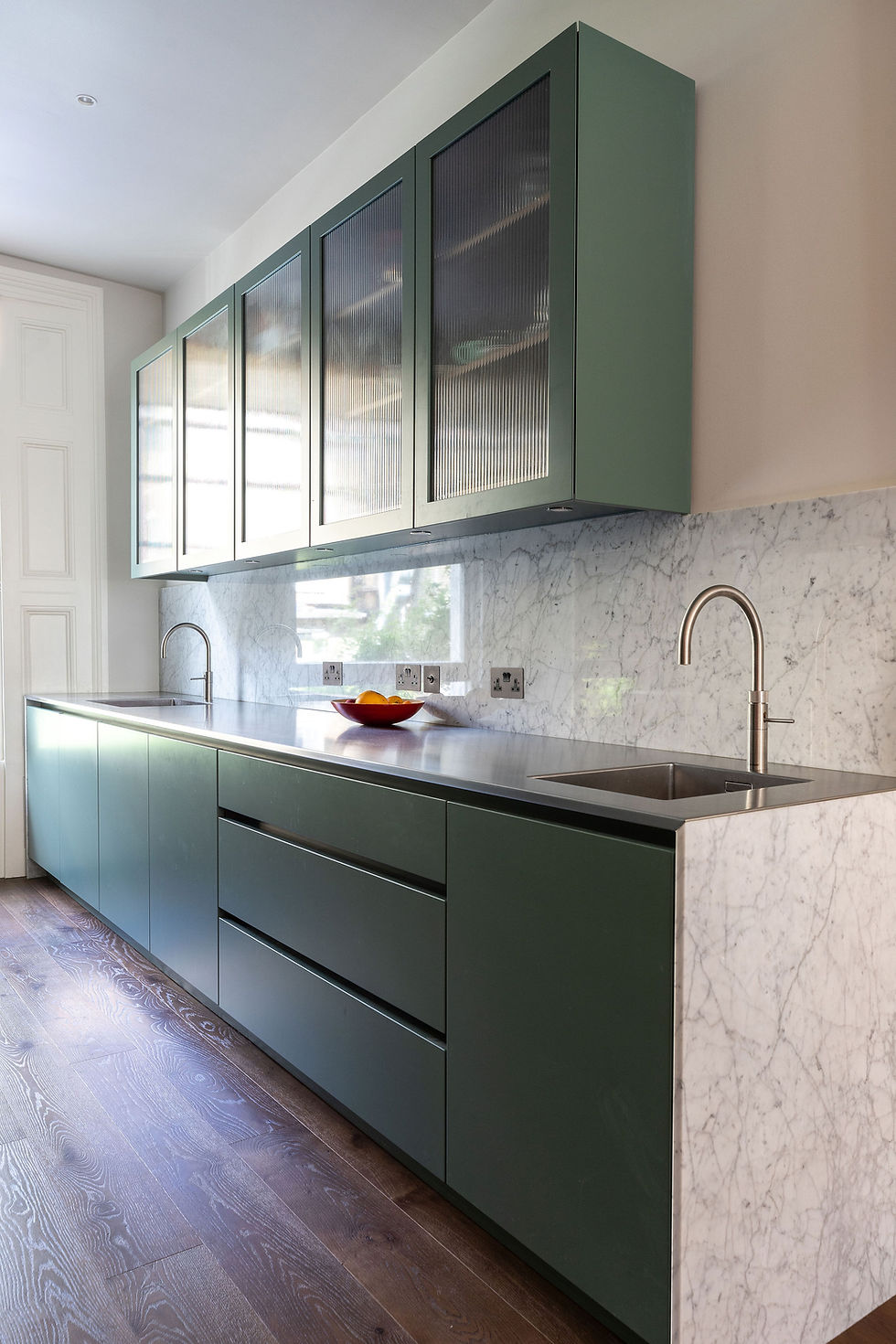
The open plan kitchen in the clients' new home
Example 2:
Our clients contacted us prior to putting in an offer on a house near Gospel Oak. The house had lots of potential, but lacked a suitable space for an open plan living-kitchen-dining space, which was a feature they wanted for their future family home. They wanted to check that the property could be adapted to their needs before finalising their offer. In particular, they were interested in whether the ground floor garage could be converted into a living space.
We undertook a two-stage feasibility study for them: First, an initial review of the ground floor layout to confirm that it would be possible to connect the garage into the rest of the house in a way that worked well with an open plan layout. Since the front of the house (with the garage) was about 1m higher than the back part of the house, this was not immediately obvious. Through the designs, we were able to confirm that this conversion would be possible and would work well.
Following purchase, we then conducted a more in-depth study. This included;
Engaging a Structural Engineer to advise on the structural work involved in converting the garage, so that we could incorporate the required structural elements in the proposed layouts from the beginning.
Engaging an Architect to confirm the requirements for the front elevation, since the property is in a conservation area.
Reviewing whether there would be benefit in adding a ground floor extension at the back of the property.
Preparing options for the overall layout, including:
How best to approach the changes in level from front to back of the house.
Where to incorporate bike storage, accessible from the front of the house.
How to create a Utility room.
An outline budget and timeline with detail of the above.
We came to the conclusion that the clients goals could be met without adding a ground floor extension – and concluded that an extension would make the ground floor very long and dark, and the resulting additional space would be awkward to use. Our clients agreed, and went ahead with a significant internal reconfiguration and renovation instead.
A layout showing how an extension would impact the space The garage before conversion The living room post renovation
If you’re unsure of where to go with your renovation or if you want to narrow down the possibilities to the best option for you/ your budget etc, please do get in touch.
We’re currently offering 25% off the cost for feasibility studies in Sep - October 2025.*
Our goal is to get the very best out of our client’s home, avoiding unnecessary overspend and ensuring the client is supported to make the right decisions for them.
*The discount applies to preparation of an Overview Budget & Timeline, and to design work associated with the Feasibility Study. Depending on the scope, a Measured Survey may also be required, to which the discount does not apply.